Drew Bauer · 11 September 2026
Material Innovations Driving Efficiency Gains in Bespoke Mechanical Assemblies
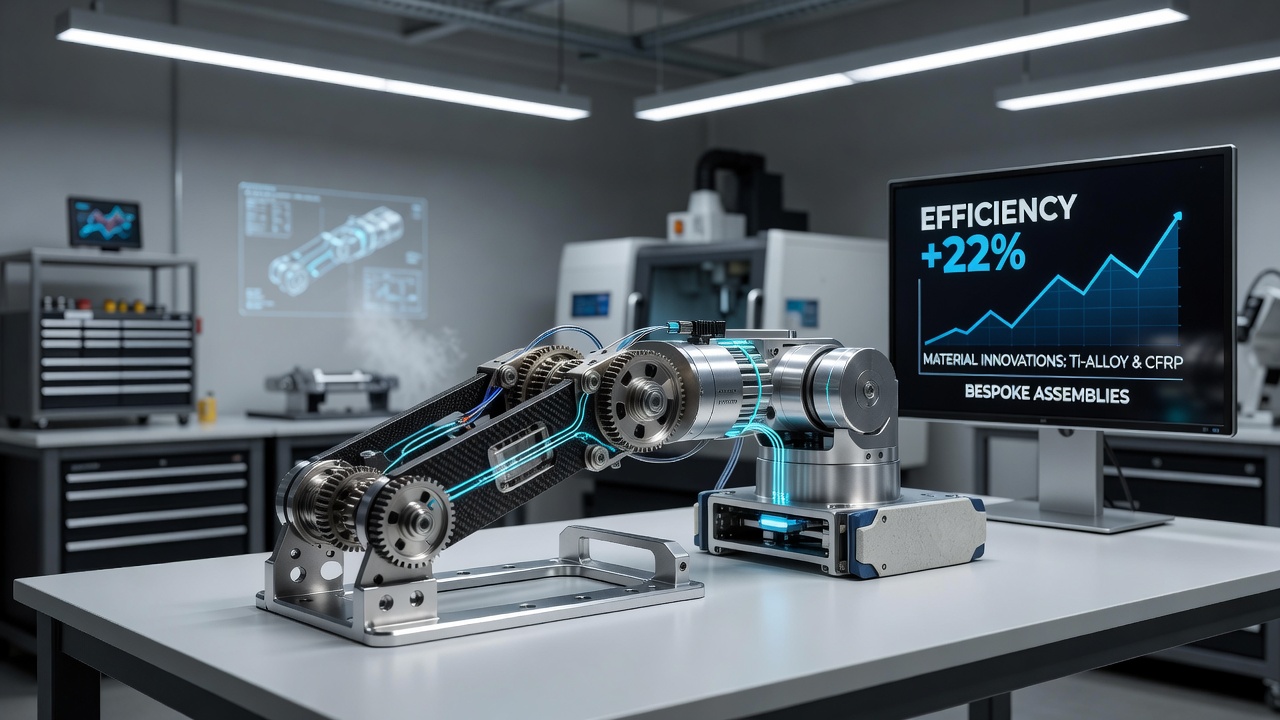
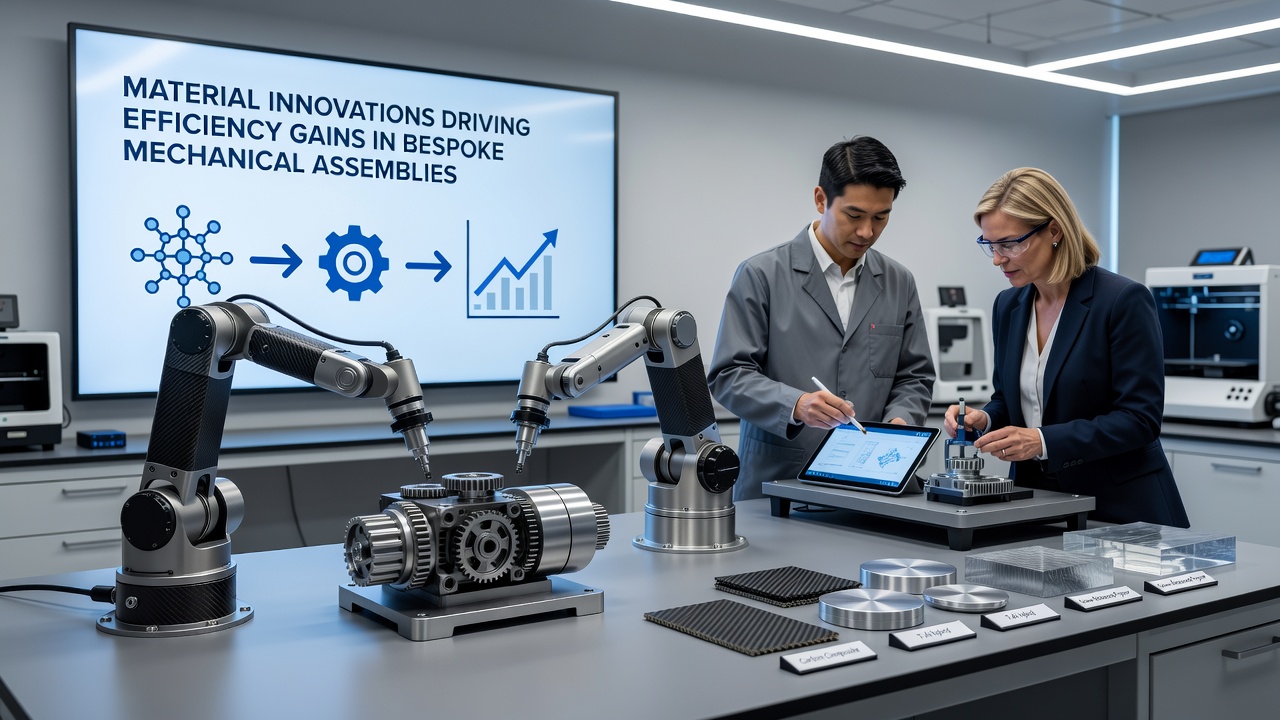
Custom mechanical assemblies have long relied on precise engineering to meet specific performance targets yet recent shifts in material science are reshaping how these systems achieve efficiency. Researchers track gains in energy use, weight reduction, and operational lifespan through targeted substitutions of traditional metals with engineered composites and alloys. Data from industry reports indicate that bespoke designs now incorporate nanostructured surfaces and self-healing polymers to cut friction losses by measurable margins while maintaining structural integrity under variable loads.
Core Material Categories Reshaping Assembly Performance
High-entropy alloys stand out because their multi-element compositions deliver superior strength-to-weight ratios compared with conventional steels, and this property proves especially useful in one-off machinery where every gram counts toward overall system efficiency. Studies from national laboratories show these alloys resist fatigue better during cyclic operations, which translates into fewer maintenance intervals for specialized equipment in sectors such as precision manufacturing and robotics. Meanwhile titanium matrix composites reinforced with ceramic particles allow designers to tailor thermal expansion rates, a critical factor when assemblies must operate across wide temperature swings without binding or loosening.
Additive manufacturing feeds directly into these material advances because it permits deposition of gradient structures that transition smoothly from hard wear surfaces to ductile cores. According to figures released by the U.S. Department of Energy, parts produced this way in 2025 demonstrated up to 18 percent lower energy consumption during service compared with subtractive equivalents, largely due to optimized internal lattices that reduce mass without sacrificing stiffness. Observers note that such lattices also improve heat dissipation, which keeps lubricants and seals within optimal temperature bands longer.
Friction Reduction and Surface Engineering Advances
Diamond-like carbon coatings applied through physical vapor deposition continue to expand their role in custom bearings and sliding interfaces. These thin films lower the coefficient of friction to values below 0.1 in dry conditions, and when paired with micro-textured substrates they trap lubricant pockets that sustain performance even during start-stop cycles. European research consortia tracking industrial applications report consistent reductions in power draw for conveyor drives and robotic joints once these coatings enter the design cycle. The same coatings also resist corrosion in chemically aggressive environments, extending service life for bespoke valves and pumps used in process industries.
Integration Challenges and Measurement Standards
Translating laboratory material properties into finished assemblies requires updated testing protocols because traditional metrics often fail to capture the synergistic effects that arise when multiple innovations coexist in one component. The National Institute of Standards and Technology has updated its guidelines for mechanical testing of additively manufactured parts to include in-situ monitoring of residual stresses during build cycles. These protocols help fabricators predict how a bespoke housing will behave once installed, reducing the number of prototype iterations needed before final delivery.
Supply chain considerations also influence adoption rates. Specialty powders and filaments must meet tight compositional tolerances, and traceability systems now link each batch to performance data collected during qualification runs. In September 2026 the International Conference on Advanced Materials will convene sessions focused on scaling these verification methods for small-batch production, where cost per part remains a limiting factor for many independent machine builders.
Industry Applications Demonstrating Quantifiable Gains
Aerospace tooling suppliers have documented specific efficiency improvements after switching to carbon-fiber-reinforced thermoplastics for custom jigs and fixtures. One program tracking assembly line operations recorded a 12 percent drop in cycle time because the lighter tools allowed faster robotic handling without compromising positional accuracy. Similar substitutions appear in medical device manufacturing, where bespoke surgical instrument handles made from magnesium alloys reduce surgeon fatigue during extended procedures while still meeting sterilization requirements.
Automotive prototype shops report parallel benefits when they integrate graphene-enhanced lubricants into custom transmission prototypes. Friction mapping conducted on dynamometers shows measurable torque gains at low speeds, and these translate into more accurate simulation models for production vehicles. Academic groups at the University of Toronto have published comparative studies confirming that such material pairings maintain their advantages across temperature and load ranges typical of real-world duty cycles.
Conclusion
Material innovations continue to expand the design space available for bespoke mechanical assemblies, with documented efficiency improvements arising from lighter structures, lower friction interfaces, and more durable surface treatments. Standards bodies and research institutions supply the measurement frameworks that allow these gains to be verified and replicated across different production scales. As fabrication techniques mature, the gap between laboratory performance and field results narrows, enabling more consistent outcomes in custom machinery across multiple sectors.